
A Hidden Masterpiece in the Kitchen: How a Multi-Million Dollar Cimabue Painting Shook the Art World

AI Image - Copyright © Realniistorii.com
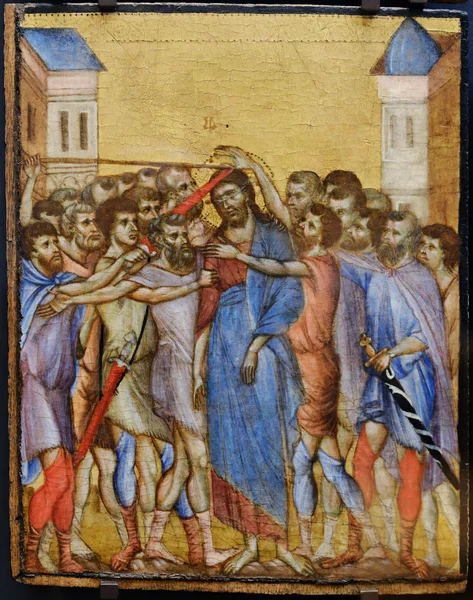
In the quiet French town of Compiègne, in an entirely ordinary house, time seemed to stand still. An elderly woman went about her daily life, never suspecting that above her kitchen stove, amidst the scents of cooking, hung a painting that would shake the art world to its core. This was no mere decoration, but The Mocking of Christ by Cimabue. The painting is also known as Christ Mocked.
It became a sensation after experts identified it as a lost 13th-century masterpiece. The dust on the canvas's surface had obscured a gold-leaf background that had not seen the light of a gallery for centuries, remaining hidden from the eyes of historians.
When the auction house Actéon arrived to appraise the woman's estate, they expected to see mundane household items, but instead stumbled upon a treasure that changed everything. In a world where every work of art is cataloged and tracked, the fact that a Cimabue painting had spent decades in a kitchen felt like a scene from a movie. This discovery not only raised questions about the provenance of the items in the home but also revealed how history can be buried under layers of daily life and oblivion, waiting for the right gaze to recognize the genius behind the faded paints.
Chronicle of an Unexpected Discovery
It all began in June 2019, when the woman decided to clear out her home before moving. She invited a local appraiser to look at items she considered unimportant, including the small painting measuring 26 by 20 centimeters. The appraiser, Philomène Wolf, immediately noticed something unusual in the way light reflected off the work's gold-leaf finish. Although the painting was covered in decades of kitchen grease, the style of Cimabue—the pioneer of the Italian Renaissance—was unmistakable to a trained eye.
Weeks of intensive laboratory research followed, including infrared reflectography. They confirmed the work's authenticity. Experts determined that it was part of a diptych depicting scenes from the Passion of Christ, a series created around 1280. The news of The Mocking of Christ by Cimabue spread like wildfire, causing shock among art historians. Until then, they had believed that all parts of this cycle were long lost or destroyed. The owner, who had not even suspected the value of the object, remained bewildered by the scale of the historical significance of her kitchen find.
The auction was scheduled for October 2019 in Senlis, France, and the atmosphere in the hall was electric. Collectors from all over the world competed for the right to own this lost masterpiece, which until recently had been valued as a common household object. The final price of 19.5 million euros was not just a number, but proof of how a chance encounter with art can rewrite a family's destiny and return to the world a piece of its cultural heritage that was thought to be gone forever.
The Investigation and Hidden Clues in the Archives
The investigation into the painting's origin revealed grim details about the fate of other items in the house. While 'The Mocking of Christ' was saved, other items from the same home were sent to the landfill after being valued at a mere 6,000 euros. This discrepancy in valuation highlights how easily history can be lost due to a lack of expert intervention at a critical moment. Secrets from the past often hide in the most ordinary objects that pass through generations without anyone asking the right question.
Documents from the Actéon auction house reveal that the woman inherited the painting from her ancestors, but no one in the family had any idea of its value. Experts noted:
“The painting was the subject of careful study, which proved that the wooden panel and pigments correspond to the technique of Cimabue from the end of the 13th century, without any doubt as to its authenticity.”
This report put an end to all speculation regarding the work's origin, turning it into a legitimate historical artifact.
However, the question remains as to how exactly the painting ended up in this French home. Some historians suggest it may have been part of a larger collection dispersed during wars or economic crises in the past. The lack of written traces in family archives makes it impossible to track every owner, which adds an extra layer of mystery to the story. Every scratch on the frame and every stain on the canvas tells a story of survival that transcends the art itself.
Clash of Hypotheses: Official Version vs. The Unspoken
The auction house's official version is clear: it was a lucky coincidence where an expert stumbled upon a masterpiece during a routine check. Critics, however, point out that it is extremely strange how such a significant work remained unnoticed for so long. Some researchers suggest that there may have been attempts at identification in the past that were suppressed or misdocumented to avoid tax or legal complications. This raises the question of whether The Mocking of Christ by Cimabue is just the tip of the iceberg.
Archives from The Art Newspaper show that such cases of “discovered” masterpieces are often accompanied by complex legal battles over ownership. In the case of Cimabue, the speed with which the painting was brought to auction raised doubts about whether important historical research that could have revealed more about the work's context had been overlooked. Although the Actéon auction house insists that everything was done by the book, the lack of transparency regarding previous owners remains a subject of debate in academic circles.
There is also the hypothesis that the painting was part of a larger diptych that was divided into parts as early as the 19th century to facilitate its sale to private collectors. If this is true, then The Mocking of Christ by Cimabue is just one fragment of a much larger puzzle that will likely never be fully assembled. This uncertainty is what gives the story its specific flavor of an unfinished investigation, where every new clue leads to even more questions.
Resolution, Traces in Time, and the Unclosed Page
Today, the painting is in a private collection, far from the eyes of the general public, which only reinforces its aura of untouchability. The owner who discovered it in her kitchen changed her life forever, but left behind a void in art history that is unlikely to be filled. The question remains: how many more masterpieces are hiding in the homes of unsuspecting people, waiting for their moment of glory?
The story of Cimabue reminds us that the past is not lost; it is simply sleeping under layers of dust and oblivion. And sometimes, frying grease. Every time we hear about such a find, we ask ourselves what else we have missed. This unclosed page in the history of art continues to stir minds, proving that the truth is much stranger and more captivating than any fiction.