
The Council of Chalcedon: A Clash of Dogmas That Reshaped the Christian World
AI Image - Copyright © Realniistorii.com
The October morning of 451 AD in Chalcedon did not bring the warmth of the autumn sun, but rather the chilling humidity of the Bosphorus, which pierced the stone walls of the Church of Saint Euphemia. The air inside was heavy, saturated with the scent of burnt incense, the damp wool of cloaks, and a suppressed fear that hovered among the hundreds of bishops in attendance. At this critical moment, as imperial envoys measured the space with their heavy footsteps, no one suspected that the Council of Chalcedon would become the stage for the greatest schism in the history of Christianity. An unexpected noise from collapsing wooden paneling interrupted the opening prayers, which many superstitious attendees interpreted as an ominous omen for the chaos to come.
In the center of the hall, surrounded by imperial guards, Dioscorus of Alexandria stood motionless, his eyes tracking every gesture of the papal legates. The shocking fact that initiated this drama was not merely the theological dispute over the nature of Christ, but the complete disintegration of a unity that had seemed unbreakable until the day before. As the minutes were recorded with trembling hands, it became clear that the political ambitions of Constantinople and Rome were harnessed to a mechanism that would redraw the map of civilization. Here, the truth was not being sought; here, the fate of empires was being forged, while behind the scenes, plans were being hatched to depose patriarchs and alter dogmatic postulates.
Chronicle of the Event: The Hour of Reckoning
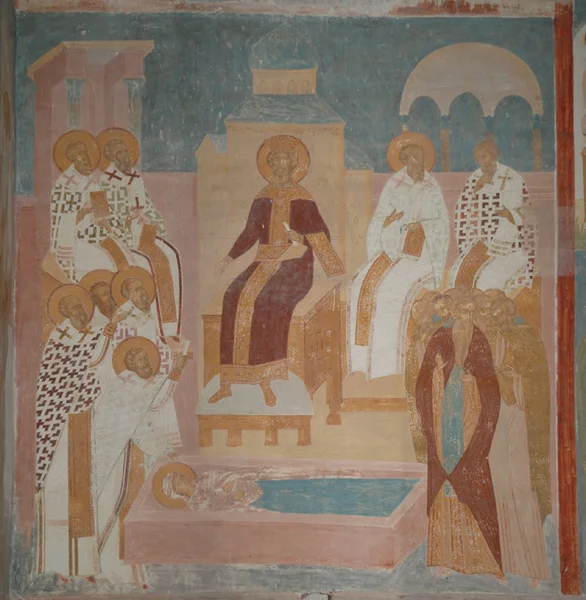
On October 8, 451 AD, in the presence of over five hundred bishops, the proceedings began with a fierce clash between the supporters of Dioscorus and his opponents. Each passing hour in the hall of the Council of Chalcedon increased the tension, and the shouts of "Anathema!" echoed in the dome of the temple like verdicts delivered by judges in a Roman trial. The psychological state of the participants was at a breaking point—many had come with hope for peace, only to be met by an organized inquisition against heretical views that had been accepted as the norm until recently. The imperial commissioners, dressed in heavy purple robes, constantly interrupted the speakers, demanding a discipline that was physically impossible in such a heated atmosphere.
Reconstructions of the events show that the debates were carefully orchestrated by the Byzantine court, which aimed to neutralize the influence of the Egyptian Church. Dioscorus attempted to defend his positions, but his voice was often drowned out by the chants of his opponents, who demanded his immediate exclusion. Chronicles describe how some of the weaker-willed clergy fell into a state of shock, seeing their brethren turn into implacable enemies before their eyes. This was not merely a religious dispute, but a demonstration of political power, where every gesture of dissent was recorded as an act of state treason.
Deep in the archives, evidence is preserved of how, in the late hours of the day when the candles began to burn low, negotiations moved into small meeting rooms. There, bribes, promises of titles, and threats of exile were exchanged, remaining hidden from the eyes of the general public. In these shadowy corners, the Council of Chalcedon transformed from a spiritual forum into an arena for political horse-trading. All those present understood that the next day would not bring compromise, but a final division that would separate East from West forever.
The Investigation and Hidden Clues
Examining the surviving protocols of the Council of Chalcedon, researchers have encountered strange discrepancies in the signatures on key documents. Some appear to have been added subsequently, as if extracted under pressure after the conclusion of the official sessions1. Material evidence—fragments of letters found in the personal archives of exiled bishops—reveals the existence of secret correspondence with Emperor Marcian. These letters prove that the majority had been instructed on how to vote long before the council even opened, making the entire process a massive theatrical production.
"We did not come here to seek God's will, but to fulfill the imperial order, which was read to us under threat of death and confiscation of property," reads a fragment from an anonymous diary discovered in a monastery near the Bosphorus.
Analysis of these texts shows that the Council of Chalcedon was a screen for a deep structural change in the state's governance. Experts note that some of the most influential voices in the church were mysteriously "removed" from the protocols after expressing disagreement with the formulation regarding the two natures of Christ. This erasure of traces is a classic technique of Byzantine bureaucracy, aimed at creating an illusion of unanimity in a moment of deep schism. It is likely that the true protocols will never see the light of day, as they would reveal the true cost of the church's peace.
The strange discrepancies do not stop there, as the physical placement of the bishops in the hall was also subject to manipulation. In the archives of the Vatican Secret Archives, plans of the hall have been discovered that suggest supporters of a certain dogma were placed near the exits to be easily controlled or removed if necessary. This architectural strategy of intimidation is proof of how far the state machine went in its attempts to impose its version of history. Every clue points to a well-planned operation intended to legitimize the emperor's power over the conscience of the believers.
Clash of Hypotheses: Official Version vs. The Silenced
Official historiography stubbornly maintains that the Council of Chalcedon was a triumph of theological clarity, necessary to save dogma from heresy. According to this version, the participants reached a consensus through inspired debates that purged Christian teaching of the ambiguities threatening its very existence. However, this official version sounds unconvincing given the scale of the subsequent persecutions and social unrest in the Orient. Many researchers believe the council was merely a tool for imperial consolidation, aiming to subordinate independent bishoprics to the dictates of Constantinople.
Alternative archival data that has emerged in recent decades paints a very different picture—a picture of resistance and hidden dissent. Many communities in Egypt and Syria never accepted the decisions of Chalcedon, viewing them as a betrayal of the apostolic heritage. These groups created parallel hierarchies that exist to this day, carrying with them the memory of the "stolen council." In these circles, oral tradition tells of bishops who were forced to sign documents without even reading them, due to language barriers or threats to their lives.
The contradictions between what is recorded in the official acts and the real history of the people who were present are striking. While Constantinople celebrated the victory of its doctrine, a process of alienation began on the periphery of the empire, which weakened the state's defense against future invasions. The Council of Chalcedon, instead of uniting Christianity, laid the foundations for its fragmentation, which later facilitated political changes in the region. This is a classic example of how a theological victory can turn into a geopolitical defeat in the long run.
Resolution, Traces in Time, and the Unclosed Page
Today, the site where the Council of Chalcedon took place is covered by the layers of time and the modern urban environment of Istanbul. The building of the Church of Saint Euphemia has long since disappeared, and with it, the physical evidence of the dramatic scenes that unfolded more than 1,500 years ago. Nevertheless, the energy of that event continues to live on in the divisions of modern Christian communities. The surviving participants were scattered to all corners of the world at that time, carrying with them the scars of the anathemas that were exchanged in that fateful autumn.
Strange coincidences accompany historians who attempt to decipher the archives—often, documents disappear at critical moments in research or appear in private collections inaccessible to the general public. The question that remains hanging in the air is why such an ancient story continues to provoke such strong emotions even today. Is the Council of Chalcedon truly a closed page, or are we still living in the shadow of its decisions, unconsciously repeating the mistakes of our ancestors who placed dogma above human life?
Sources
- Vatican Secret Archives: Acts of the Council of Chalcedon
- Byzantine Historical Chronicles, Edition of 1924, Oxford University Press.