
The Radioactive Rain of Oklo: Earth’s Ancient Natural Nuclear Reactor
AI Image - Copyright © Realniistorii.com
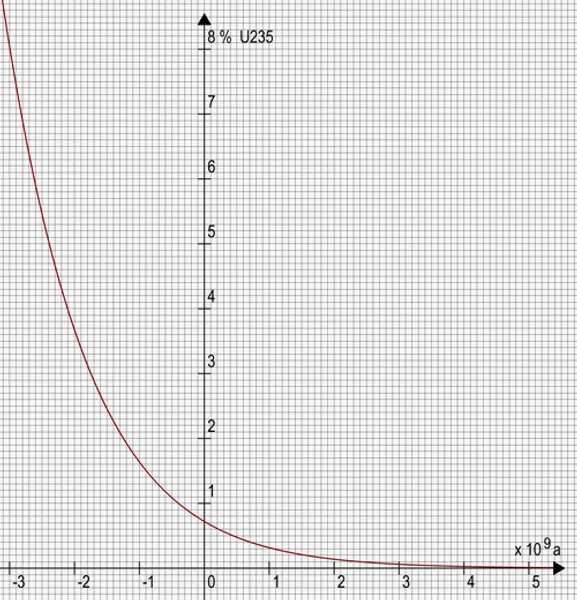
June 1972. The French town of Pierrelatte was sweltering in the heat when a routine analysis of uranium samples from the mines of Oklo, Gabon, revealed something physicists deemed impossible. In the laboratory of the French Atomic Energy Commission (CEA), the spectrometer emitted an alarming, monotonous sound as it recorded an anomalously low content of the uranium-235 isotope. All known terrestrial deposits contain exactly 0.72% of this isotope, but here the value was drastically lower—0.717%. This microscopic difference was not merely a statistical error; it was the signature of a massive, invisible event that had rewritten the laws of geology.
The air in the room grew heavy with tension as researchers realized this uranium had been “burned” in a nuclear furnace billions of years ago. This was not the result of human technology, but evidence of a natural nuclear reactor hidden deep beneath the African jungle. While the world still feared the nuclear apocalypse of the Cold War, nature had already demonstrated its ability to split the atom eons before the appearance of Homo sapiens. What was the force that turned ordinary rock into a functioning machine, and why do the traces of this process appear so eerily organized?
Chronicle of the Event
It all began with a routine question from French geologists: why did the uranium from Oklo not match the standard isotopic profile? Engineer Francis Perrin and his team from the CEA began a detailed on-site study, traversing the dense vegetation of Gabon to reach the remote mines. They discovered that nearly two billion years ago, during the Proterozoic era, conditions in Oklo were unique on the planet. The concentration of uranium-235 was much higher than it is today, and the presence of groundwater acted as a neutron moderator, necessary for maintaining a critical mass.
Scientists determined that the reaction was not a single explosion, but a prolonged, pulsating process that lasted hundreds of thousands of years. This natural nuclear reactor operated in cycles, switching on when water levels rose and shutting down when the heat caused the water to evaporate. Engineers were astonished by the self-regulating nature of this geological phenomenon, which functioned with the precision of a Swiss watch. The psychological state of the team shifted from skepticism to pure scientific shock as they realized they had discovered the first atomic power plant in Earth’s history, created by the planet itself.
Documenting every meter of the mine became a race against time as samples were sent back to Paris for confirmation. Each extracted core of sedimentary rock told a story of radioactive rain that had seeped into the earth's strata, leaving behind fission products identical to those in modern reactors. Participants in the expedition described the site as a “sacred place of physics,” where even the soil seemed different under the influence of the centuries-old radiation. They understood that Oklo was not just a deposit, but a portal to the distant past that overturned our understanding of the development of matter.
The Investigation and Hidden Clues
The investigation deepened when scientists discovered the presence of neodymium and ruthenium isotopes, which are direct products of nuclear fission. These elements are “fingerprints” that cannot appear naturally in nature unless they have undergone an intense process of nuclear combustion. In the CEA reports published in the journal Cosmos and Science, it is emphasized that the reactor at Oklo was capable of purifying its own waste in a way that modern engineers still cannot fully replicate. This discovery sparked a wave of questions regarding the stability of the Earth's crust over billions of years.
“The observed isotopic anomalies in Oklo are so precise that they not only prove the existence of a natural nuclear reactor but also call into question the constancy of the fundamental constants of physics over time.”
Strange inconsistencies began to mount when researchers noticed the absence of radioactive waste in the surrounding area. Instead of dispersing, the fission products remained trapped in the crystal lattice of the rocks, as if they had been “preserved” by some unknown geological force. This led to hypotheses that Oklo could serve as a model for the safe storage of nuclear waste—a problem that still plagues humanity today. But behind the scientific enthusiasm lies the uncomfortable truth that nature managed to do what we only achieved in the mid-20th century.
Is it possible that Oklo is not the only place on the planet with such a history? Researchers began analyzing other deposits in Gabon and neighboring regions, looking for signs of “ancient activity.” Physical evidence—altered mineral structures and radioactive markers—shows that Oklo was a complex ecosystem where biological and geological processes interacted with nuclear physics. Every new protocol reveals that this natural nuclear reactor operated under conditions that were on the verge of catastrophe, yet nature found a way to maintain balance.
Clash of Hypotheses: Official Version vs. The Unspoken
Official science insists that Oklo is a pure coincidence—a lucky convergence of geological factors, water, and high uranium content. According to this version, there is no need for external intervention or “intelligent design,” as the laws of probability explain everything. However, many researchers point out that the probability of all these factors occurring simultaneously and sustaining a reaction for 150,000 years is astronomically small. This lack of conviction gives rise to alternative theories that are often ignored by academia due to a lack of conventional evidence.
Documents declassified decades later show that military departments were interested in Oklo not for the sake of science, but for the potential lessons in energy transfer. There are reports that attempts were made to model this natural nuclear reactor in laboratory conditions, which ended with unexpected results—instability and an inability to control power output. Why did nature succeed, while the best minds of humanity face such difficulties? This contradiction remains in the shadow of official reports, which prefer to downplay the complexity of the phenomenon.
Some critics argue that Oklo is only the tip of the iceberg and that other, as-yet-undiscovered “nuclear zones” likely exist on Earth. These zones may have been active during different eras, leaving behind traces that we interpret today as natural mineral formations. The conflict between the official conclusion of “coincidence” and the sense of “precision” remains open. Even with the advanced technology we possess, we are only just beginning to understand the secrets hidden in the Earth's crust beneath our feet.
Resolution, Traces in Time, and the Unclosed Page
Decades after the discovery, the mine at Oklo was closed, and the site is under strict monitoring by international organizations. Nevertheless, the mystery of this natural nuclear reactor continues to attract scientists who see in it not just a geological curiosity, but a warning. We are merely toddlers in mastering atomic energy, while the planet was “experimenting” with it even before the appearance of complex organisms. Was Oklo just another whim of evolution, or is it evidence of a cyclicity we do not yet understand?
The surviving participants of the first expeditions often recall the strange feeling they experienced while collecting samples—a mixture of awe and fear in the face of something greater than human understanding. The site today is quiet, overgrown with jungle, but the radioactive isotopes deep underground continue their slow decay, reminding us of a time when the Earth “breathed” through nuclear fire. Oklo remains an open page that forces us to look at the ground with more respect and less arrogance. If nature had its own reactor, what else is it capable of creating while we were busy learning how to light our first fire?