
The Mary Celeste: The Abandoned Ship and the Shadows Cast by Legend

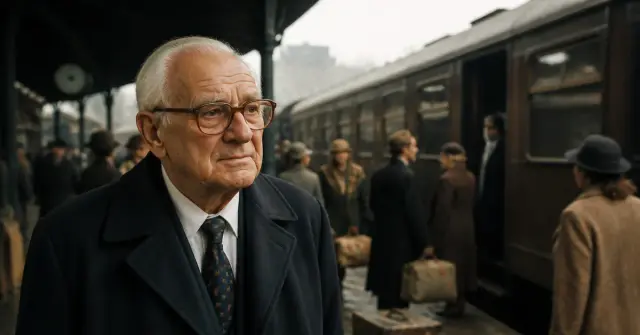
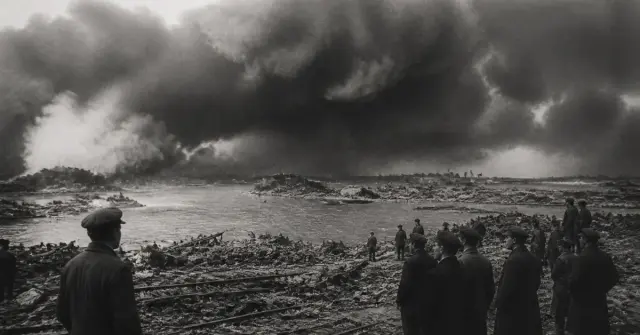
Illustrative reconstruction of the event.
In early December 1872, the crew of the Dei Gratia encountered a ship drifting in the Atlantic Ocean that appeared to be abandoned. It was the Mary Celeste. There was no one on board, and the ship's lifeboat was missing. The story begins with a concrete discovery, but it does not conclude with an account from those who could have explained what happened.1
It is precisely the absence of testimony from the missing that allows the imagination to fill in the gaps. The more extraordinary the narrative becomes, the harder it is to distinguish which details are rooted in documents and which were added later. The primary task here is not to invent a new version, but to clarify the framework of the mystery.
Who Was Aboard the Ship
The American merchant ship was sailing from New York to Genoa with a cargo of industrial alcohol. Captain Benjamin Briggs was accompanied by his wife, Sarah, their young daughter, Sophia, and seven crew members—ten people in total. The final entry in the ship's log was dated November 25.2
These details make the story a human one, rather than just a maritime enigma. It was not an abstract "crew" that vanished, but a group of people with a specific mission and destination. The missing lifeboat is a crucial clue, as it suggests the ship was abandoned. However, in itself, it does not explain the reason, the timing, or what transpired afterward.
The state of the vessel as found is insufficient to reconstruct the captain's final decisions. The condition in which the rescuers found the ship may differ significantly from what the captain perceived when assessing an immediate risk earlier. This is a limitation of historical reconstruction, not proof of a specific danger.
How Fiction Becomes "Fact"
In 1884, Arthur Conan Doyle published a fictional story based on the case. According to the Royal Museums Greenwich, it was this literary retelling that contributed to the spread of inaccurate details and even a misspelling of the name as "Marie Celeste."1
A work of fiction has the liberty to fill in the gaps. A historical account does not, unless it clearly labels the speculation. When the two types of text are conflated, a beautiful detail can survive longer than a documentary correction. Therefore, the absence of a dramatic detail in a reliable source should not be compensated for by its popularity.
Scenes that allow us to "step into" a precise moment in the lives of the missing are particularly suspect. If no one left such a record, such a scene is a literary construction, regardless of how many times it has been repeated.
A Possible Cause Is Not a Proven Event
Investigations and subsequent analyses have discussed the state of the pumps, water in the hold, navigation, and route conditions. A Smithsonian publication regarding the work of documentarian Anne MacGregor examines a combination of practical problems as a possible explanation for the abandonment.3
The value of such an approach is that it seeks solutions within the ordinary constraints of seafaring. However, a proposed sequence of events does not automatically become an established historical fact. That would require data linking a specific danger to the specific decisions made by the people involved.
Otherwise, we risk replacing one legend with another—one that is more technical, yet just as definitive. Plausibility is necessary for a good hypothesis; it is not sufficient for proof.
Where the Mystery Remains
What is certain is that the ship was found without its people. No definitive answer has been established as to what happened to them.2 This is what must remain at the end of the story, rather than a promise that the secret has finally been solved.
The Mary Celeste is also a lesson in reading: sometimes the greatest mystery is not an added extraordinary fact, but the missing link between several perfectly ordinary ones. You can find more such cases in Mysteries, and stories with documented resolutions in True Stories.
Sources
- The mystery of the Mary Celeste — Royal Museums Greenwich
- An Abandoned Merchant Ship Was Discovered Floating in the Atlantic in 1872 — Smithsonian Magazine
- Abandoned Ship: The Mary Celeste — Smithsonian Magazine