Magura Cave: The Human Silhouettes We Have Yet to Fully Decipher

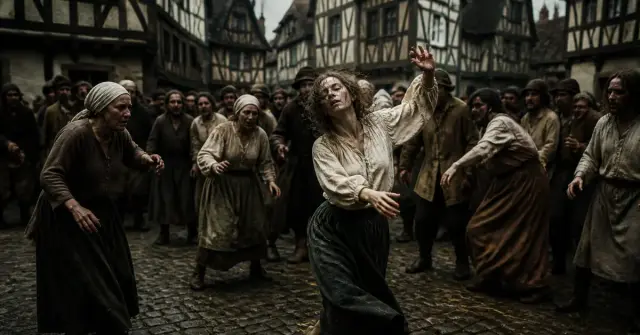
Illustrative reconstruction for the article.
In Magura Cave, the most profound sense of human presence does not come from a named portrait. It comes from silhouettes: figures with raised arms, people, animals, and signs etched into the walls. The cave near Rabisha brings together natural history and the traces of communities that lived millennia before us.2
The images are visible, but their exact meaning is not always clear. Recognizing a human figure does not mean we know who created it, for whom it was intended, or what it was meant to evoke in the viewer.
Two Different Eras in One Space
Official presentations of Magura Cave describe the cave's ancient geological origins separately from its human use during prehistory. The nomination description published by UNESCO notes traces of habitation, settlement remains, and drawings within the halls and galleries.1
These layers of time should not be conflated. The age of the rock formation is not the age of every image upon it. A cave may exist long before humans use it; various human traces within it may also belong to different periods.
The distinction sounds simple, but it is crucial to the narrative. A headline that transfers the millions of years of geological formation onto the drawings does not make the site more mysterious; it replaces its real antiquity with an incorrect chronology.
What We See and What We Assume
The Ministry of Tourism describes scenes featuring human figures, animals, and various symbols, as well as the use of bat guano in the painting process. Some of the images are presented as dancing, hunting, or masked people.2
This is a starting point for interpretation, not a word-for-word translation. A pose may suggest an action, and the proximity of figures may imply a connection between them. However, the story of a specific ritual, its participants, and their words does not automatically follow from the outlines.
It is helpful for the reader to distinguish between three levels. The first is what is actually visible. The second is how researchers interpret it. The third is what the modern narrator adds to fill the gaps. Only the first two have a place in a documentary text, and they must be clearly distinguished.
Why the Calendar Requires More Careful Wording
The tourist description includes an interpretation of some of the signs as a solar calendar.2 The idea is attractive: to look at the wall as a way of organizing time, rather than just a series of drawings.
However, this article does not accept the popular presentation as sufficient grounds to declare an independently proven record for the earliest calendar. Such a conclusion requires an examination of the dating, the method of interpretation, and comparisons with other findings. Recognizing repetition does not, in itself, establish a single possible meaning.
This is not a rejection of an interesting hypothesis. On the contrary: when we call it an interpretation, we can ask the right questions of it. What observation supports it? Which part remains a conjecture? What would another explanation of the same signs look like?
Magura and UNESCO: An Important Clarification
The cave has been on Bulgaria's Tentative List for UNESCO since 1984. This is not equivalent to being inscribed on the World Heritage List. The nomination description also considers the likely ritual function of the gallery with the drawings.1
There is no need to exaggerate the status to appreciate the site. The true encounter is with people who left images that have outlived their explanations. Their proximity lies in the recognizable bodies; the distance lies in the meaning we cannot fully recover.
In Bulgarian Stories, we seek exactly these encounters between place, memory, and the unknown. And Secrets from the Past continues the question of how to read a trace when the dictionary for it is missing. Magura deserves this careful look, not a ready-made answer invented in place of its creators.
Sources
- The Magoura cave with drawings from the bronze age — Tentative List — UNESCO World Heritage Centre
- Magura Cave — Ministry of Tourism