
Endurance: When Shackleton’s Goal Became Survival

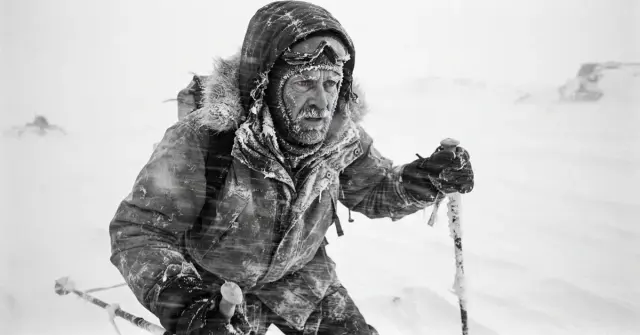
Illustrative reconstruction for the article.
When we look at a photograph of a ship trapped in ice, it is easy to see only adventure. For the people forced to remain there, that same sight presents a very practical question: where will the next opportunity for movement come from? In 1915, the Endurance, Sir Ernest Shackleton’s ship, became caught in the icy grip of the Weddell Sea. The original intention to cross Antarctica gradually gave way to a different, more urgent task.1
There were 28 men on board. Their story is often told as a test of a single leader, but the number is significant: every decision had to preserve the group, rather than merely offering a chance to the strongest. From that moment on, geographical achievement was no longer the sole measure of success.
The Day the Ship Ceased to Be a Refuge
The Endurance sank on November 21, 1915. This date is also noted in the description of a photograph from the Royal Collection Trust. It should not be confused with the earlier abandonment of the damaged vessel.2
The distinction between these two moments helps us understand the shift. Abandoning the ship still left the object visible; it could be observed, remembered, and used as a landmark. Sinking removed even that support. From then on, returning could no longer be imagined as a simple repair or a continuation of the original plan.
We do not know what each man thought in that moment, and there is no need to invent final words addressed to the ship. It is sufficient to acknowledge the established fact that the expedition's primary resource was gone. Subsequent actions had to be organized around the remaining possibilities.
The Small Boat and the Great Distance
After moving toward Elephant Island, Shackleton and five others set off in the small boat James Caird toward South Georgia. Later, Shackleton, Frank Worsley, and Tom Crean crossed the island to reach a whaling station. The rescue of those left on Elephant Island finally came in August 1916.1
Here, the narrative can easily turn into a convenient formula: a brave leader makes a decision, and everyone is saved. But such a summary ignores the navigation, the technical skills, the maintenance of group morale, and the external assistance. Between the decision and the result lay a series of tasks that could not be accomplished by confidence alone.
The return of the 28 men from the Endurance is the specific success we speak of. It should not be expanded into a claim that the entire larger expeditionary initiative proceeded without human loss. The historical framework matters, even in the most inspiring of stories.
A Drawing in a World of Ice
The Royal Museums Greenwich preserves a work by the artist George Marston, depicting the ship amidst the ice. The museum's description tracks the material circumstances of its creation within the expeditionary environment.3 This is a different kind of trace than a list of routes and dates.
The drawing does not prove how everyone felt. It shows that what was experienced was not only endured but also observed and preserved in form. For us today, such an object restores an individual perspective to a history that might otherwise easily shrink into a map with a few arrows.
It is the combination of these traces that makes the narrative resilient. Photography fixes a specific moment. A museum object preserves someone's labor. Chronology connects the actions. None of these supports should be burdened with telling more than they are capable of.
Success as the Abandonment of the Original Goal
The most powerful turn in the story of the Endurance is not a victory over nature. The ship was lost, and the original plan was not realized. The strength lies in the shift of the mission: when circumstances made the original goal impossible, the men were not sacrificed in its name.
This is not a survival guide, nor does it prove that the right mindset overcomes every danger. It is a documented history of decision-making, skill, and collaboration. You will find other human stories with equally specific costs of choice in True Stories.
Sources
- Sir Ernest Shackleton — Royal Museums Greenwich
- The party after the ship's destruction, Ocean Camp — Royal Collection Trust
- Endurance trapped in ice, George Marston — Royal Museums Greenwich