Sutton Hoo: The Ship in the Earth and the Nameless King

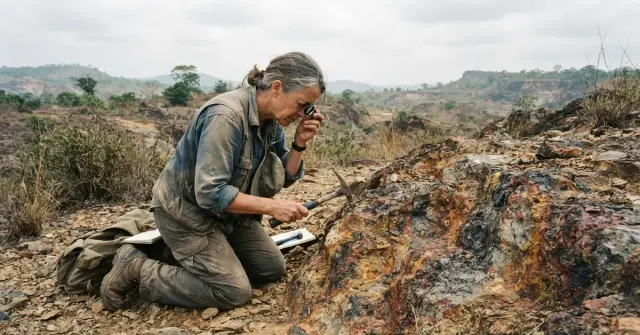
Illustrative reconstruction for the article.
Beneath a mound in Suffolk lies not a ship that could simply be unearthed and set to sail, but the ghostly imprint of a massive wooden vessel and a burial chamber filled with extraordinary artifacts. While the wood has largely decayed, the outline and surviving remnants allow the ship to be clearly identified.1
This is one of the unique powers of archaeology: an absent object can sometimes leave behind enough traces to be understood. At Sutton Hoo, however, this power has its limits. The burial speaks volumes about high status, yet it leaves behind no undisputed name.
The Curiosity of a Landowner
Edith Pretty commissioned an investigation into the mounds on her estate. Basil Brown began the work in 1938; the following year, excavations of the great mound revealed the true scale of the discovery. Subsequently, a team of specialists joined to meticulously examine the burial chamber.2
It is vital to remember all those who participated in this story. The discovery does not belong solely to the moment the gold appeared. It depended on the decision to dig, the careful attention to the soil, and the recognition of seemingly modest fragments.
The findings were later donated by Pretty to the British Museum.4 Thus, a personal interest in the mounds gained a public legacy. The objects could be studied as a cohesive find rather than being scattered as individual curiosities.
Wealth That Points Beyond the Horizon
The burial inventory includes weapons, vessels, ornaments, and the iconic helmet. The British Museum highlights the distant connections evident in some of the materials and items. This was not a closed world, isolated from the rest of Europe and beyond.1
However, an object from afar does not in itself prove that the person buried there traveled to the place of its manufacture. Between origin and final resting place, there could be trade, gift-giving, and multiple owners. The find reveals connections; the exact route must be proven independently.
This caution does not make the history any less rich. On the contrary, it allows us to see how many different human relationships can lie behind a single object. Its value lies not only in the metal but in the journey we cannot fully reconstruct.
The Ruler as a Probability, Not a Signature
The burial dates to the early 7th century. King Rædwald is often proposed as a possible identity, but the museum’s presentation explicitly clarifies that no certain name can be assigned.1
This is the exact type of uncertainty that deserves to remain visible. The wealth and labor invested support a high social status, but they are not equivalent to an inscription naming the individual. When we turn "possible" into "proven," we replace an archaeological conclusion with a convenient character.
The paradox is profound: the burial was likely intended to cement the memory of a specific person, yet for us, that person remains the most obscure part of the find. The objects of display survive, but the full identity does not.
The People Who Preserved the Discovery
The Sutton Hoo archive includes photographs by Barbara Wagstaff and Mercy Lack. The National Trust emphasizes the importance of their photographic documentation of the excavations.3 It is a legacy in its own right: not the ancient burial, but the modern moment in which it became visible once more.
Thus, the story has two layers of human memory. One is the funerary intent from centuries ago. The other is the work of the people who recognized, studied, and captured it.
Sutton Hoo does not need a ghostly guardian to remain mysterious. It is enough to ponder how so many objects can survive around a person whose name we cannot speak with certainty. You will find other such encounters with the incomplete past in Secrets of the Past.
Sources
- The Anglo-Saxon ship burial at Sutton Hoo — British Museum
- History of archaeology at Sutton Hoo — National Trust
- Visiting Tranmer House at Sutton Hoo — National Trust
- Sutton Hoo — National Trust Collections — National Trust