
Tunguska: Why the Massive Explosion Left No Typical Crater

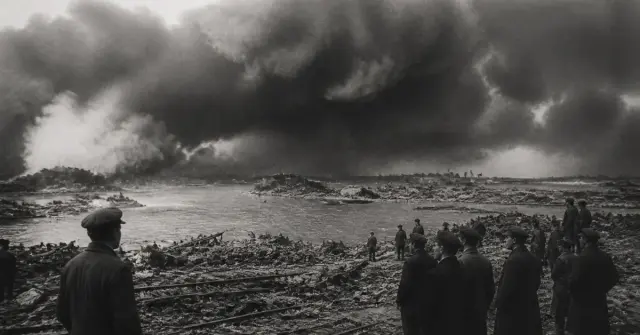
Illustrative reconstruction of the event.
On June 30, 1908, an explosion occurred over a remote region of Siberia, flattening a vast expanse of forest. Witnesses described a brilliant phenomenon and a thunderous roar. Yet, when researchers finally reached the affected area, they were not met with the familiar sight of a large meteorite resting at the bottom of a crater.1
This absence fueled a multitude of conjectures. If something came from space, where is the hole? The question sounds logical only as long as we assume that every cosmic object must reach the ground intact. Tunguska is a story of something else: destruction caused above the surface.
The Forest as a Witness
Leonid Kulik led the first successful expedition to the region in 1927. Nineteen years had already passed between the event and the direct investigation of the site. The team discovered vast stretches of flattened trees, while in the central zone, some trunks remained standing, though stripped of their branches.1
This delay is significant. Tunguska was not captured by a dense network of cameras and sensors at the moment of the event. The investigation gathered various traces after the fact. Such a task is more akin to reconstructing a scene from remaining evidence than reviewing a complete video recording.
And yet, the forest is not a blank slate of evidence. The direction and nature of the damage are observations that any proposed explanation must account for. They constrain the narrative: not every sensational version can produce the same result.
What an Airburst Means
The prevailing scientific explanation is the fragmentation and powerful release of energy from a cosmic body within the atmosphere. The shockwave reached the ground without the need for a large, intact object to carve out a corresponding crater. NASA describes Tunguska precisely as such an event.2
Here, "explosion" does not necessarily mean a planted explosive device. The word describes the rapid release of energy and its consequences. If this meaning is lost, the natural phenomenon can easily be retold as the trace of an unknown weapon.
The lack of a crater is not a lack of an explanation. It is one of the reasons to consider a process occurring in the air rather than a simple impact on the surface. This is an important shift: the strange trace may actually support the physical explanation rather than automatically refuting it.
What We Still Don't Know for Certain
The size, composition, trajectory, and altitude of the destruction were not measured directly with modern instruments in 1908. Estimates depend on models and the constraints used. Research compares various simulations and verifies them against better-observed events, such as the one over Chelyabinsk in 2013.3
This explains why popular publications provide different figures. A discrepancy in the estimation of one parameter does not mean that all basic mechanisms are equally likely. There can be significant uncertainty regarding the exact size of the body while simultaneously having strong grounds for the airburst explanation.
A good reconstruction should show both. Overly precise numbers create false confidence; the phrase "nobody knows anything" erases the knowledge that has actually been accumulated. Between these extremes lies the more difficult, but more useful, narrative.
A Place Transformed by Nature
Modern satellite imagery shows an area of forests, wetlands, and traces of long-term natural recovery. The landscape no longer resembles a fresh catastrophe. NASA Earth Observatory uses this very comparison between the historical event and today's surface.2
Tunguska belongs in Unexplained not as proof of a supernatural force, but as an example of how a famous mystery receives a compelling physical framework. The remaining unknowns are an invitation for research, not an open space for just any story. For other cases where documents change the initial picture, explore Secrets from the Past.
Sources
- 115 Years Ago: The Tunguska Asteroid Impact Event — NASA
- A Cosmic Explosion over Siberia — NASA Earth Observatory
- Tunguska Revisited: 111-Year-Old Mystery Impact Inspires New Predictions — NASA