

The Mystery of the Wow! Signal and the 1977 Deep Space Radio Pulse

AI Image - Copyright © Realniistorii.com
The quiet night of August 15, 1977, at the Ohio State University's Big Ear radio observatory was interrupted by an event that would challenge our understanding of the universe. At 11:16 PM, the IBM 1130 computer began printing a series of symbols unlike anything previously encountered in astrophysics. As the paper fed from the printer, it carried evidence of a transmission whose intensity spiked and then faded over exactly 72 seconds. At that moment, no one in the facility suspected they were encountering the greatest enigma in human history: the Wow! signal.
The air in the room was thick with the scent of overheated electronics and dust, the only sound being the rhythmic clatter of the print head against the perforated paper. Jerry Ehman, the astronomer who would later analyze the data, did not know he held in his hands something that millions would interpret as the first contact with extraterrestrial intelligence. This was not mere noise from a distant galaxy or an equipment error; it was a precisely structured radio pulse originating from the direction of the constellation Sagittarius. The cold of space felt suddenly closer when realizing this signal might have been sent thousands of years ago, traveling through the void only to be captured by us on an ordinary summer night.
Chronicle of Events at the Observatory
Work at the Big Ear radio observatory in the 1970s was an exhausting, monotonous task requiring infinite patience and attention to detail. Researchers, part of the Space and Science program, scanned the skies for traces of extraterrestrial civilizations using massive antennas aimed at the darkest corners of the galaxy. When the Wow! signal appeared on the monitors, it did not cause immediate panic, but rather confusion among the duty team, who initially attributed it to terrestrial interference.
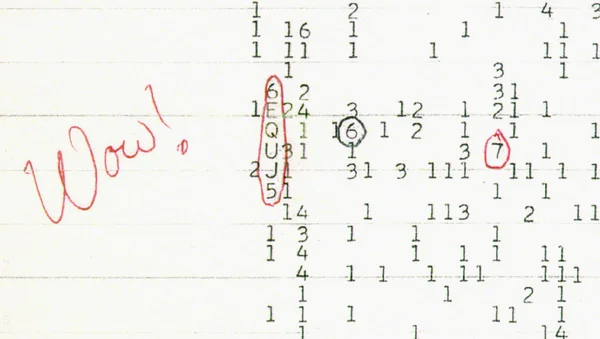
Jerry Ehman, who reviewed the data days later, was stunned by the printout, marking the sequence "6EQUJ5" in red ink and adding the legendary exclamation that gave the phenomenon its name. Each digit and letter in this code corresponded to the signal's strength, with "U" representing its peak intensity—30 times stronger than the usual background noise of space. The team's psychological state fluctuated between scientific skepticism and an intuitive sense that they had witnessed something fundamental. They rechecked all antenna settings and frequency filters, attempting to find a terrestrial cause for the anomalous emission, but found no evidence of a defect.
The analysis process continued for weeks, with each team member attempting to find a logical explanation for the signal's 72-second trajectory. They mapped the celestial sphere, comparing the recording to the positions of known satellites, planets, and radio sources, but every lead proved false. Even after decades, the lack of a repeat signal remains the greatest obstacle for scientists attempting to prove its extraterrestrial origin. This event became a benchmark for SETI, though many today wonder if we missed the only chance for dialogue the universe ever offered us.
The Investigation and Hidden Clues
The investigation into the Wow! signal passed through phases of paranoia and a frantic search for truth within the archives of the Ohio State University Radio Observatory. Ehman and his colleagues explored the hypothesis of a signal reflected from space debris or even a passing comet, whose hydrogen cloud might have emitted at the 1420 MHz frequency. This frequency is not random—it is characteristic of hydrogen, the most abundant element in the universe, which is why it is considered a "universal language" for interstellar communication. 1
The archives contain numerous reports revealing how close the scientists were to declaring the discovery as definitive proof of extraterrestrial intelligence. However, scientific protocol demanded a caution that often bordered on denial of the obvious to avoid academic scandal. One of the lead researchers at the time wrote in his personal diary:
"If this is a natural phenomenon, it is so perfect and isolated that it borders on an artificially created code. We are not looking for aliens; we are looking for evidence that we are not alone, but when we find it, we are afraid to look the truth in the eye."
Discrepancies in witness accounts emerged only years later, when some of the young assistants at the observatory shared that they had noticed strange secondary disturbances in the days before and after the event. These data, however, were never officially published, as they were dismissed as "noise" or "electromagnetic interference from the nearby highway." This gap in documentation leaves room for conspiracy theories suggesting that government agencies may have reviewed the data before it became public. Today, reviewing these archives, one is left with the feeling that we were on the verge of a major shift that was intentionally or unintentionally suppressed by bureaucratic caution.
Clash of Hypotheses: Official Version vs. The Unspoken
Official science has for decades stubbornly insisted that the Wow! signal was the result of a natural phenomenon, most likely radio emission from a passing comet or a gas cloud. This version, however, sounds unconvincing to many, as it does not explain the precision of the frequency and the fact that the signal was detected by only one of the antenna's two horns. If the source had been a celestial object, it should have been registered by both receivers as it moved through the field of view. 2
Alternative hypotheses, supported by researchers outside mainstream academic circles, offer much more intriguing scenarios, including directed laser or radio transmissions from advanced civilizations. They argue that the signal was a "directed beam" intended for someone else in space, and Earth simply happened to be "in the way" of that emission for a short time. Declassified documents from the SETI Institute Archives suggest that there was heightened interest in such anomalies during the 1970s, which was sharply curtailed after the end of the Cold War.
The controversy deepens when analyzing the mathematical structure of the signal, which shows signs of modulation atypical for random noise. Why does the official version remain so categorical in rejecting any possibility of intelligence, even though mathematical models suggest otherwise? It is possible the answer lies in the fear of social chaos or a lack of sufficient funding for follow-up research. Every new technology we use today to scan the skies only confirms that the Wow! signal remains one of a kind, unable to be reproduced or fully explained.
Resolution, Traces in Time, and the Unclosed Page
Today, the Big Ear observatory no longer exists; it was dismantled in 1998 to make way for a golf course, as if history were trying to erase the traces of that August day. Jerry Ehman passed away in 2015, but his question remains hanging in the void: "Where are they?" Attempts to re-detect the signal with the most powerful modern radio telescopes have led to nothing, leaving us with the bitter feeling that we missed the moment of truth.
Perhaps most unsettling is that we continue to send signals into space, hoping someone will answer, without having fully understood what we received 47 years ago. The mystery of 1977 is not just a historical curiosity, but a reminder of our insignificance in the face of a vast and likely inhabited universe. Were we being watched, or did we simply overhear a random conversation of a civilization that has long since vanished?