
Asteroid 2008 TC3: The First Predicted Cosmic Event in History

AI Image - Copyright © Realniistorii.com
The night over the Nubian Desert in Sudan is usually silent, broken only by the distant howl of the wind, but on October 7, 2008, the sky became the stage for an apocalyptic spectacle. At exactly 05:46 local time, a bright light tore through the darkness, turning night into blinding day for a fraction of a second. This was not a meteor that caught everyone by surprise; it was the first predicted cosmic event in history, precisely calculated by astronomers just hours before the impact. Earth stood on the threshold of a new era, where humanity for the first time did not merely observe a random cosmic incident, but knew exactly when and where the intruder from deep space would strike.
The air shook with a powerful shockwave that rolled over the desert sands, leaving behind the scent of ozone and burning stone. Witnesses on the ground described a sound resembling thunder that did not fade, but seemed to tear the celestial vault to pieces as objects that had traveled for millions of years disintegrated in the Earth's atmosphere. This incident was not just another piece of space debris, but proof that our planet is vulnerable, yet also that our technology had finally reached the level required for early warning. This episode from the Space & Science section reveals the truth behind 2008 TC3 and why this event forever changed our survival strategy.
Chronicle of the Event: Discovering the Threat
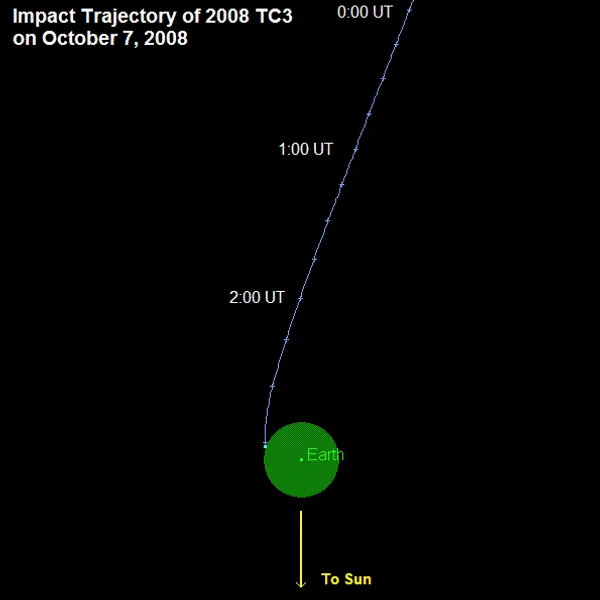
It all began on October 6, 2008, when Richard Kowalski, working at the Mount Lemmon Observatory in Arizona, spotted a small, fast-moving object. Initially, no one attached serious importance to this small speck on the sensors, but the automated algorithms of the NASA Near Earth Object Program immediately calculated the trajectory. The results were startling: the object, later cataloged as 2008 TC3, was heading directly toward Earth with a potential collision in less than 20 hours. This was the first predicted cosmic event in history, placing scientists in a state of unprecedented mobilization.
Astronomers around the world began feverishly pointing their telescopes toward the designated sector of the sky to confirm the calculations. The tension in the control rooms was palpable, as every new frame confirmed the inevitable: the collision was not a question of "if," but "when." The psychological state of the researchers shifted from skepticism to intense concentration as they tried to determine the exact composition and size of the object. It was clear that 2008 TC3 was small, about 4 meters in diameter, but its speed made it a dangerous projectile.
In the hours before the impact, the scientific world tracked every movement of the asteroid with surgical precision. People in observatories worked without interruption, exchanging data through the Minor Planet Center to refine the forecast. No one slept, as this was a test of our ability to predict the future of the planet. When October 7 arrived, the world already knew that the Nubian Desert would be the place where this cosmic drama would conclude.
The Investigation and Hidden Clues
After the dust settled over Sudan, the real scientific investigation began, aiming to answer exactly what this visitor had been. Expeditions of scientists, led by Peter Jenniskens, headed into the desert to search for debris that could reveal the secrets of the solar system. Finding meteorites in the endless sands was like looking for a needle in a haystack, but the efforts were rewarded with the discovery of hundreds of small fragments. These stones were not ordinary; they were evidence of a complex geological history that had been abruptly interrupted by the collision with the Earth's atmosphere 1.
The investigation revealed strange discrepancies between theoretical models and the recovered debris, which raised new questions among experts. Here is what one of the lead researchers at the time shared in a report on the incident:
"Analysis of the collected fragments showed that 2008 TC3 was an extremely fragile object, likely composed of many smaller pieces held together by weak forces. This explains why it disintegrated so spectacularly at a high altitude instead of reaching the surface as a single, massive projectile that would have caused greater destruction."
This physical evidence challenged our previous notions of how asteroids withstand atmospheric entry. The hidden clues in the mineral composition of the meteorites, now known as "Almahata Sitta," allowed scientists to understand that many objects we consider solid rocks are actually "rubble piles." This discovery forced space agencies to revise their planetary defense protocols, as potential threats can behave in a much more unpredictable manner than expected 2.
Clash of Hypotheses: Official Version vs. The Unspoken
The official version of 2008 TC3 seemed clear: a classic collision of a near-Earth object that was detected in time thanks to advanced technology. However, among some independent researchers, doubts arose regarding the full transparency of the data. Some critics argued that the reaction time was too short and that if the object had been larger, the world would have fallen into a panic for which governments were not prepared. These alternative voices pointed out that there is data on other objects that have passed by Earth unnoticed, which casts a shadow over our confidence.
The controversy deepened when it became clear that tracking 2008 TC3 was only possible because of its high speed and specific approach angle. What would have happened if the object had arrived from the direction of the Sun, where telescopes are blind? Official documents often fail to highlight these "blind spots" in our surveillance system, preferring to focus on the success of the prediction. This clash of hypotheses between NASA's optimistic reports and the skeptical analyses of amateur astronomers leaves a sense of fragility.
In the archives, one can find declassified data showing that military radars detected the object even earlier than civilian observatories, but the information was not shared immediately. Why was there a delay? Was time needed for risk assessment, or was it simply bureaucratic inertia? These questions remain hanging, reminding us that even when we believe we control the sky, we are only observers in a game of cosmic chance, where the rules are written by gravity and chaos.
Resolution, Traces in Time, and the Unclosed Page
Today, the site in the Nubian Desert where the debris of 2008 TC3 fell is a subject of scientific interest, but also of a peculiar melancholy. The years following the event proved that this was not an isolated incident, but the beginning of more serious monitoring of celestial bodies. The sands of Sudan still hide small pieces of this asteroid, which continue to appear after every sandstorm, reminding researchers that the cosmos never forgets its guests. The question that remains is not whether there will be a next time, but how prepared we are to meet the next visitor.
This unclosed page in human history forces us to look at the stars with caution. Every time we look at the night sky, we are aware that out there, objects are moving that could change the course of our civilization in a matter of minutes. 2008 TC3 was a warning sent by the universe that we managed to read in time, but will we have the same luck when the next "big rock" heads toward us? The cold of space and the silence of the desert remain the best witnesses to our vulnerability.