Mary Anning: The Woman Who Unearthed Ancient Seas from the Stone

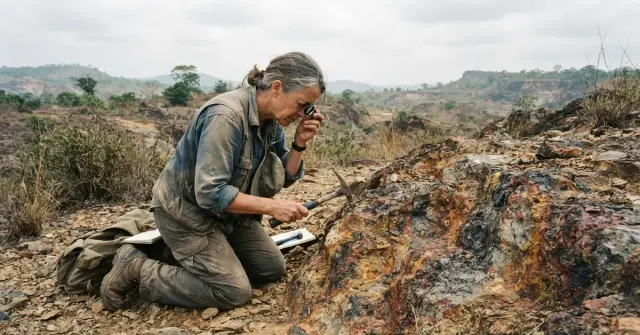
Illustrative reconstruction for the article.
Along the shores of Lyme Regis, the cliffs guard the remains of a world that never knew human witnesses. Mary Anning began searching for fossils there as a child, alongside her father. Born in 1799 into a family of limited means, she learned to discover, clean, and sell her findings, later teaching herself anatomy and geology.1
This beginning is far from the romanticized image of someone simply strolling along and finding treasure. Discovery requires a keen eye, but also immense labor after the initial sighting. The stone must be understood, the remains extracted and prepared, and the individual parts recognized as a cohesive whole.
A Skeleton That Did Not Fit the Known World
Among her early significant finds was an ichthyosaur, discovered with the help of her brother Joseph. Museum records trace how the skull and the rest of the skeleton became subjects of study. Later, in 1823, Anning discovered a remarkable plesiosaur skeleton.2
These animals had to be named with care. Ichthyosaurs were marine reptiles, not fish and not dinosaurs. A similar body shape does not imply a common origin, and living in the sea does not place all large ancient animals into a single group.3
For the reader, this is a minor linguistic correction. For the history of science, distinguishing between unknown forms is essential work. A discovery does not come with an explanation attached; it must be compared with other remains and placed within a broader understanding of life.
When the Strange Breeds Suspicion
The plesiosaur appeared so unusual that it initially sparked doubts about whether it was a composite of parts from different animals. The Natural History Museum describes how additional drawings and evidence helped overcome these doubts.1
This episode is particularly interesting because it highlights the difference between verification and dismissal. An extraordinary object deserves careful examination, but authoritative skepticism alone cannot replace the scrutiny of evidence.
Anning continued to find specimens that expanded the known diversity of ancient animals. Among them was a pterosaur from 1828, described in museum materials as the first such discovery outside of Germany.2 The sea, the land, and the air of the past gradually gained distinct inhabitants.
The Discovery Gets a Name, the Labor Does Not Always Get Recognition
Anning's biography reveals the inequality between her contributions and her access to the scientific society of her time. The work of the woman who found and prepared the specimens did not always receive credit in the publications describing them. She was never accepted as a member of the Geological Society of London.1
Here, the inspiring story should not be concluded with the convenient assurance that talent always overcomes obstacles. The achievement is real, but so are the barriers. If we erase the latter, we render invisible the labor we are trying to honor.
There is also a practical side: the scientific value of a find does not guarantee a sustainable income for the discoverer. The journey from the shore to a museum collection can bring fame to the object without providing the same security to the person.
In the tale of such a discovery, there are two distinct victories: noticing something important and convincing others to take it seriously. They do not always occur simultaneously. It is precisely the distance between labor and recognition that makes Anning's story more than just a list of found fossils.
Returning the Discoverer to the Display Case
The Lyme Regis Museum is built on the site of the Anning family home and incorporates her legacy into the story of the town.4 This restores the location of human labor to the location of scientific discovery.
Her story is powerful not because we need to invent a secret epiphany, but because observation, knowledge, and perseverance left material traces. The fossils continue to be studied; the name of the person who helped make them visible must remain with them. For more discoveries that change our perception of the world, continue to Secrets from the Past.
Sources
- Mary Anning: The unsung hero of fossil discovery — Natural History Museum, London
- Mary Anning fossils: Seven highlights from the Jurassic Coast — Natural History Museum, London
- What is an ichthyosaur? — Natural History Museum, London
- About Lyme Regis Museum — Lyme Regis Museum